The IRTA International Course on Meat Products Technology is a consolidated course in the sector, focused on the modernization and industrialization of the meat industry.
The course offers an exhaustive review of all aspects related to the technology and quality of meat and meat products: obtaining the raw material, processing, packaging, processing technologies and industrial trends.
On this web page you can register for the courses by clicking on the "I want to register" section.
Dates: From 11/07/22 to 11/25/22
• Module 1: Technology and quality of meat and fresh meat derivatives. From 07/11/22 to 11/11/22
• Module 2: Technology of raw-cured and salted sausages. From 11/14/22 to 11/18/22
• Module 3: Technology of cooked meat products. From 11/21/22 to 11/25/22
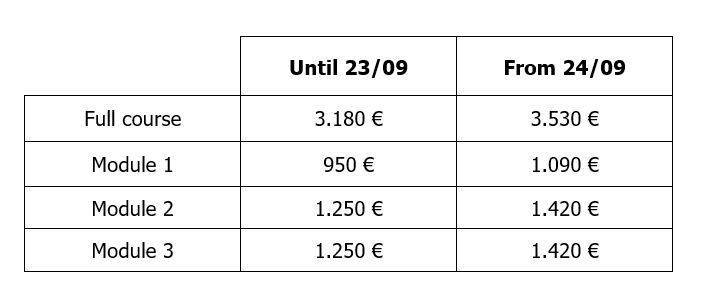
Prices without VAT
Partially subsidized course by the FUNDAE.
The prices include lunches on school days and daily transport from Girona to the IRTA of Monells for those who previously request it.
Way to pay:
Payments will be made by bank transfer to the current account that will be provided at the time of registration confirmation.
Cancellation:
For registration cancellations after 10/07/2022, a cancellation fee of 50% of the registration value will be charged. The organization reserves the right to cancel the course at any time prior to 11/07/2022. In case of cancellation of the course, the organization will return the registration fee.


Grau Matas holds a degree in Food Technology and Food Management. Since 2010, he has been part of the Food Quality and Technology Program at IRTA (Institute for Agrifood Research and Technology). His activity has focused on research projects, contracts, training, and technical advice to companies on topics related to the improvement and development of food products from alternative protein sources, process technologies (specialised in extrusion and dry fractionation), and the development of meat products (fresh, cooked, and cured). Related to training, he has participated in courses and technical seminars for knowledge transfer to companies in the food industry. He has coordinated the International Course in Meat Products Technology, the Course in Meat Analogue Technology and the International Course in Dry Cured Meat Products.
Dr. Maria Dolors Guàrdia holds a degree in Agricultural Engineering (1996) and a PhD in Agricultural Engineering (2003) from the University of Lleida. Since 1996, she has been a researcher at IRTA, within the Food quality and technology programme, where she undertakes, among other responsibilities, systematic monitoring and assessment of food legislation.
Her professional activity is primarily carried out through public research projects and collaborative contracts with private companies, both nationally and internationally, in the field of food technology and food processing. Her work encompasses the application of conventional processing technologies as well as new and emerging technologies, including high-pressure processing, radiofrequency, and Pulse Spray Drying.
She has dedicated a substantial part of her career to the design and implementation of studies involving trained/expert sensory panels and consumer panels. She has been involved in the international course since its inaugural edition.
.
Dr. Jacint Arnau holds BSc. in Chemistry (1981) and PhD in Veterinary Science from the Universitat Autònoma de Barcelona (1991). He served as Head of the Food Engineering and Technology Unit (1985-2009) and Head of the Food Technology Program at IRTA (2009-2015). With 34 years of experience in meat technology, particularly in dry-cured meat products, he has developed extensive collaborations with food companies and research institutions at both national and international levels. He is the author or co-author of 9 patents and more than 200 publications, including 113 papers published in peer-reviewed scientific journals. He received the Scientific Achievement Award at the 6th World Ham Congress (Lugo, Spain, 2011), the José Flores Innovation Award (Madrid, 2022), and the Llonganissa d’Or Award (Vic, Spain, 2026). He has been listed among the top 2% most influential scientists worldwide according to Stanford University (2022) and among the 20 most influential scientists in the history of the journal Meat Science (2025). He has directed and organized international courses on meat products and has served as a lecturer in this course since its inception.
Filiberto Sanchez holds BSc. in Food Science and Technology from the University of the Basque Country, MSc in Food Quality Assurance from the University of Reading and a PhD from the University of Girona. He worked for four years in the private sector, in companies related to the meat industry and has been working at IRTA since 2003, carrying out research, training, and technical support activities for companies in the field of meat processing technology, with particular expertise in dry-cured and fermented meat products. He has been responsible for numerous industry contracts and has participated in national and international research projects. Since 2007, he has been the director of the International Course on Meat Products Technology and, since 2013, of the International Course on Dry-Cured Meat Products. Responsible for customized training courses for companies from Spain, Europe, and Latin America.
Dr. Anna Claret holds a PhD in Food Technology, a Master's degree in Food Biotechnology, and a Technical Engineering degree in Agri-food Industries. She joined IRTA in 2003 and currently works as a researcher in Sensory and Consumer Science within the Food Quality and Technology Programme.
Her research focuses on consumer behaviour and perception, sensory optimization of food products, and the development of innovative food products through the active involvement of consumers and other stakeholders across the food value chain throughout the different stages of the innovation process. She has extensive experience in the recruitment, training, and management of sensory panels, as well as in the development of methodologies for the sensory evaluation and characterization of food products.
In addition, she facilitates creativity and co-creation processes aimed at fostering innovation in new product development. Throughout her career, she has participated in numerous consultancy projects for private sector and in more than 40 national and European research and innovation projects.
Dr. Claret is the author of over 40 peer-reviewed scientific publications and several book chapters. She served as Vice President of the Spanish Association of Sensory Analysis Professionals (AEPAS) from 2019 to 2025.
Dr. Maria Font holds a degree in Agricultural Engineering (1994). She earned her PhD in 2000 from the Department of Statistics and Operations Research at the Polytechnic University of Catalonia. Since 2000, she has been working as a researcher at IRTA, focusing on carcass and meat quality, as well as the use of computed tomography for the evaluation of live animals and their carcasses. She is the national expert in pig carcass classification. She has participated in and led several national and international projects. She has (co)authored more than 150 scientific publications and over 60 technical publications, as well as several book chapters.
Dr. Elena Fulladosa holds a degree in Biology (1999) and a PhD in Biotechnology (2004) from the University of Girona. Since 2007, she has been a researcher at the Food Technology Program of the Institute of Agrifood Research and Technology (IRTA). Her research focuses on the development and application of innovative technologies for the optimization of food processing, quality control, and characterization of agrifood products, with a particular emphasis on meat products and dry-cured ham.
Over the past years, she has led and participated in research projects aimed at implementing non-destructive technologies and advanced monitoring systems in the food industry. Her work has involved the application of technologies such as computed tomography (CT), X-ray-based systems, NIR spectroscopy, microwave technologies, and high hydrostatic pressure processing. She has participated in numerous European and national competitive research projects, is the author of more than 50 international scientific publications, has presented over 80 contributions at international conferences, and has supervised five PhD theses.
Her expertise in the field of dry-cured ham has been recognized through several invited lectures at the World Congress of Ham, a patent related to the optimization of dry-cured ham processing using non-destructive technologies, her involvement in the development of an industrial CT system, and her close collaboration with the meat industry.
She is currently an Associate Professor at the University of Girona, where she teaches the course Culinary Technology and New Technologies in the Bachelor's Degree in Food Innovation and Safety. She also serves on the Board of Directors of the Catalan Association of Food Sciences.
Degree in Pharmacy and PhD from the Department of Nutrition and Bromatology of the University of Barcelona (2000). Currently responsible for the IRTA Food Security Program in Monells, Girona. His research activity focuses on the study and modeling of the behavior of microorganisms in food and the assessment of microbiological risks, as well as the study of the effect of classical and emerging technologies (eg high pressures, bioconservation, active packaging) to food preservation and shelf life, through predictive microbiology and laboratory tests ("challenge test"). She is the co-author of 70 scientific publications, as well as technical articles and book chapters. He has participated in numerous conferences and competitive research projects, national and international, as well as in contractual research projects with companies in the sector. She regularly contributes as an organizer, speaker or teacher in transfer conferences, seminars, undergraduate and postgraduate university courses, as well as specialized technical training. She is a member of the editorial board of the International Journal of Food Microbiology and Secretary of the Executive Board of the International Committee of Food Microbiology and Hygiene (ICFMH).
Dr. Anna Jofré holds a degree in Biology (1998) and a PhD from the University of Girona (2003). She has been a researcher in IRTA since 2003. Her R&D&I activities have mainly focused on improving food safety and extending shelf life through the application of product-based intervention strategies (natural antimicrobials and bioprotective cultures) and process-based technologies (fermentation, thermal treatments, and high-pressure processing). She evaluates their effectiveness through challenge testing and predictive microbiology and applies omics techniques for the typing and characterization of microorganisms and microbial communities from environmental and food sources.
She participates in and leads research projects as well as industry-funded contracts. She is co-author of more than 75 scientific publications in international peer-reviewed journals and more than 35 technical and outreach publications, in addition to numerous contributions to national and international conferences. She regularly delivers technical training courses and seminars.
Industrial technical engineer specializing in Chemistry from the Polytechnic University School of Girona (1981) and Agricultural Technical Engineer from the Polytechnic University School of Girona (1985). Senior researcher of the Product Quality program. Her main lines of research are the classification of pig carcasses (she is the National Expert on these issues and advisor to the MAPAMA since 2000) and the quality of the meat, as well as aspects related to slaughterhouses and 'dismemberment.
Coordinator Course
Brigitte Martinez holds a degree in Agricultural Technical Engineering (2001) from the University of Vic and the Polytechnic University of Catalonia, a degree in Food Science and Technology from the University of Girona (2005), and an Official Master's Degree in Human Nutrition and Food Quality from the University of the Balearic Islands (2010).
She is currently an Innovation Technician in the Food quality and technology programme in the Food industries area, where she contributes to the definition, coordination and implementation of applied research and technology transfer projects and contracts for the agri-food sector.
She specializes in the application, optimization and validation of batch thermal processing technologies for different food matrices, aiming to improve food safety, shelf life and the sensory quality of food products. Throughout her professional career, she has also participated in projects related to emerging food preservation technologies, including microwave processing, high-pressure processing and radiofrequency treatments.
She has extensive experience collaborating with food companies in the development and implementation of innovative solutions, as well as in training, dissemination and knowledge transfer activities. She was a member of the Local Organising Committee of ICoMST 2025 (International Congress of Meat Science and Technology) and currently coordinates the International Course in Dry-Cured Meat Products, the Curso Internacional en Tecnología de Productos Cárnicos, and the conferences and technical events organized by the Food Industries area.
Elsa Lloret holds a Bachelor’s degree in food science and technology (2001) from the Universitat Autònoma de Barcelona (UAB) and a Master's Degree (MSc) in “Polymers and Biopolymers” (2013) from the Universitat Politècnica de Catalunya. She worked for six years in the private sector (Dairy Fermentation and Sensory Analysis Engineer in the R&D Department at Danone) and, since 2006, has been working as an Innovation Technician within the Food Quality and Technology Program at IRTA.
Her activities focus on contract research, training, and technical consultancy services for companies in the field of food packaging. She specializes in plastic materials for food applications and their use in innovative packaging and preservation technologies aimed at extending shelf life, improving sustainability, developing new products or new processes tailored to market needs.
Dr. Núria Panella Riera holds a degree in Chemistry (2001), and a degree in Food Science and Technology (2003), as well as a PhD from the University of Girona in Meat Quality (2011). She has worked at IRTA since 2003 within the Food Quality and Technologies Programme and is a member of the Carcass and Meat Quality Expert Group. Her research focuses on meat quality from technological, sensory, nutritional, and social or ethical perspectives.
She is involved in research projects assessing the relationship between meat quality and various factors such as genetics, ante-mortem and post-mortem conditions, nutrition, and animal sex. She has also conducted studies on the consumer acceptability, attitudes, and preferences, as well as those of stakeholders across different stages of the meat supply chain, with regard to the quality of pork (including boar taint), beef, rabbit meat, and other species.
Currently, her work focuses on applying of post-mortem strategies to enhance the sensory quality of meat, particularly in termps of tenderness, aroma, and flavour. Her specialisation lies in the production of dry-aged meat, not only from beef but also from other species such as pork and lamb.
She has delivered training courses on meat quality to companies, Master's students, and students at the Empordà Agricultural Training School.
Dr. Pere Gou is a senior researcher in the Food Quality and Technology Program of the Institute of Agro-Food Research and Technology (IRTA). Doctor in Agricultural Engineering from the Polytechnic University of Valencia in 1993. He has been leading the Food Quality and Technology Program from 2015 to 2023. Since joining IRTA in 1991, he has participated in 28 national projects, leading 7 of them. He has been a member of the scientific committee of three international congresses. He has participated in 14 European projects, being the leader of a work package in 4 of them. He has published more than 160 publications (more than 120 in indexed scientific journals) and has licensed 4 patents. He has been an associate professor at the University of Girona for 16 years (1998-2014) and has supervised 10 doctoral theses. During this period, he has worked mainly with meat products, although also in applications to other foods. The lines of research have focused on the study of the modifications that both ingredients and transformation or preservation technologies (both traditional and new) cause in the characteristics of foods (from technological properties to sensory properties), as well as on the development of non-destructive methods for monitoring the characteristics of foods and food processes. His main lines of research at present are the modelling of the effects of ingredients and technologies in the processing and preservation of foods and the development of at-line, on-line and in-line analysis methods of product quality and process supervision.
Josep Comaposada holds a degree in Agricultural Engineering from the University of Lleida (1994) and a PhD in Thermal Engineering from the Polytechnic University of Catalonia (UPC). Since 1999, he has been a researcher at the Food Quality and Technology Unit of the Institute of Agrifood Research and Technology (IRTA). His research focuses on food engineering, with particular emphasis on the development of innovative technologies and control tools integrating simulation and NIR spectroscopy, among other techniques. Since joining IRTA, he has participated in numerous national and European research projects, as well as collaborative projects with industry partners. The outcomes of his research include the licensing of five patents, the development of the IRTAsim web-based simulator, and numerous scientific publications, some of which are specifically focused on the drying and drying systems of meat products. He has delivered multiple training courses and workshops related to the drying and drying equipment used in meat products. He has combined his research activities with teaching as an Associate Professor at the University of Girona (2004–2014; 2016–2026)..
Joel González has been an Innovation Technician at IRTA's Food Quality and Technology Programme since 2006. He holds degrees in Biology and Food Science and Technology from the University of Girona (UdG), and a Master's degree in Human Nutrition and Food Quality from the University of the Balearic Islands (UiB). His work focuses on the quality of meat and meat products from a technological, nutritional and sensory perspective. Throughout his professional career, he has participated in numerous research and innovation projects at both national and international levels, covering a range of livestock species, including pigs, cattle, poultry, sheep, goats and horses. He has also been actively involved in applied research and technological development projects in collaboration with agri-food companies, particularly within the meat sector, contributing to the improvement of product quality, shelf life, differentiation and value enhancement. In addition, he carries out technical diagnosis, consultancy and specialised training activities for the industry, providing tools and knowledge to support the continuous improvement of processes and products.
Albert Brun i Pujol holds a degree in Agricultural Engineering (2010) and a Master's Degree in Food Biotechnology (2011) from the University of Girona. Since 2009, he has been a member of IRTA's Food Quality and Technology Programme. His work focuses on carcass and cuts classification at slaughterhouses, carcass cutting, and the assessment of carcass and meat quality through the application of advanced technologies. He also works on the application of computed tomography for determining the tissue composition of live animals, carcasses, and cuts, as well as on the non-destructive analysis of food products and the monitoring of their evolution during processing, preservation, and storage.Since 2010, he has been a lecturer on the International Course on Meat Products and has participated in workshops and training activities aimed at knowledge transfer to the meat industry.
Dr. Xavier Serra holds a degree in Biochemistry, a Master's degree in Biotechnology, and a PhD in Biochemistry from the Universitat Autònoma de Barcelona (2001). He is a researcher in the Food Quality and Technology Programme within the Food Industries Area of IRTA, based in Monells (Girona). His research focuses primarily on the technological quality of fresh meat and dry-cured and cooked meat products, particularly on reducing fat and salt content and improving technological quality. His research also encompasses high-frequency thawing and cooking technologies (microwave and radiofrequency heating), as well as high-pressure food processing.
He has participated in more than 20 European and national research projects, as well as contract R&D projects with companies in the food sector. He is the co-author of 32 scientific publications, several technical articles in trade and professional journals, and five book chapters. He has presented more than 40 contributions at national and international conferences and has served as a lecturer in various national and international courses and technical workshops aimed at transferring knowledge to the food industry. In addition, he has been involved in two patents and has co-supervised three doctoral theses.
Cristina Zomeño Segado is a Beatriu de Pinós post-doctoral researcher (program co-financed by the Government of Catalonia and the European Union, H2020 COFUND ID project No 801370) and is part of the research team of the IRTA-Monells Food Quality and Technology program (Girona ). She has a degree in Veterinary Medicine from the Cardenal Herrera CEU University (2006), a master's degree in Animal Production (2007) and a PhD in Science and Technology of Animal Production from the Polytechnic University of Valencia (2013). He is a specialist in the impact of nutritional, genetic and management factors on the final quality of the product and in the evaluation of the quality of the carcass and meat of different animal species (poultry, pork, rabbits, beef) using technologies of Non-destructive and non-invasive inspection. He has participated in 6 research projects (5 national and 1 European), and has been responsible for 2 lines of research and an innovation project. She is co-author of 22 scientific-technical articles and has presented 31 communications at international and national conferences.
Belén Martín has a degree in Pharmacy (1997) and in Food Science and Technology (2000) and a PhD in Biotechnology (2005). He has focused his research on the study of pathogenic microorganisms of food origin and on the microbial communities of technological interest in meat products. It is specialized in the development and application of molecular methods for the identification, characterization and classification of microorganisms with the ultimate goal of improving food safety and quality. She is the author of more than 20 publications in SCI journals and has participated in multiple national and European projects.
Diploma in the EUPB in Technical Architecture. Since 1997 he has been part of the technical-commercial team of Supplier Hispano Holandesa SAU (Phh). Its functions include developing and/or improving products and processes in the food industry, especially the meat industry. Product manager in ingredients and specialist in technology and products for smoking, with direct training with manufacturers of aromas and smoke aromas worldwide. Technical-commercial in packaging and actively participates in the R&D of products focused on sustainability and the circular economy.
With a degree in pharmacy from the UB, she works as a consultant, auditor and trainer in food quality and safety. His professional activity focuses on conducting audits based on IFS and BRC certification standards. He teaches courses on the aforementioned rules, appcc system and prerequisites, auditor training, labeling training, aimed at food companies and the administration.
He is a member of the board of AVHIC (Association of Veterinarians and Hygienists of Catalonia).
He has contributed to the preparation of several industry guides: ACSA 2021 Basic Food Handling Handbook Manual for the person responsible for self-control in the preparation and service of meals ACSA 2021 Self-control in Municipal Markets”, Diputació de Barcelona, 2004.
Her research focuses on measuring consumer eating behavior from a multidisciplinary perspective, standardizing sensory analysis on different foods, as well as methodological sensory aspects, statistical analysis, and experimental design. He is also a professor of sensory analysis and statistics applied to different national master's degrees, a member of the "Asociación Española de Normalización" (AENOR), a founding member of the "Asociación Española de Profesionales del Análisis Sensorial" and responsible for the working group of sensometry of the “International Olive Council”.
Her research focuses on measuring consumer eating behavior from a multidisciplinary perspective, standardizing sensory analysis on different foods, as well as methodological sensory aspects, statistical analysis, and experimental design. He is also a professor of sensory analysis and statistics applied to different national master's degrees, a member of the "Asociación Española de Normalización" (AENOR), a founding member of the "Asociación Española de Profesionales del Análisis Sensorial" and responsible for the working group of sensometry of the “International Olive Council”.
Dr. Emma Fàbrega i Romans holds a degree in veterinary medicine (1995) and a PhD in animal production (2002) from the Autonomous University of Barcelona. She also completed a Master's degree in Applied Animal Behaviour and Animal Welfare (1998) from the University of Edinburgh and is a Diplomate of the European College of Animal Welfare and Behavioural Medicine in the subspecialty of Animal Welfare Science, Ethics and Law. Since 2003, she has worked at IRTA, in the Animal Welfare program, conducting research on systems for assessing animal welfare on farms, especially in pigs, and improvement strategies. She has coordinated national projects on alternatives to painful practices such as castration or tail docking in pigs, and in European projects on the application of precision technologies to improve welfare or the development of new indicators to assess welfare, and the relationship between animal welfare and sustainability. She has published more than 60 articles in indexed journals and has also participated in book chapters and publications in popular journals. She has participated as a speaker since 2003 in training conferences for livestock farmers, veterinarians, or other agents in the sector, both nationally and internationally, as well as in more than 100 presentations at conferences. She has organized and participated in numerous technology transfer conferences for the sector.
Jordi Bernardo Figueras is licensed in Chemical Sciences by the Autonomous University of Barcelona (1975). He has extended his studies to attend courses in food microbiology at the Institut Pasteur de Lille.
Total professional activitat has developed in Casademont accumulating more than 45 years of experience in the field of technology càrnia. He has occupied different levels of responsibility from the technical department to the production department and also a stage with the responsibility of the commercial and marketing area. Currently segueix col·laborant amb Casademont, a company that is currently integrated into Costa Food Group.
Antonio Villarreal Lozano, Engineer in Food Industries, graduated from the Monterrey Institute of Technology and Higher Education, has worked in the meat industry for more than 16 years in companies related to the processing of poultry, pork, beef, sausages and cooked sausages. in various positions in areas of Quality and Innovation and Development. In 2012, he joined Budenheim Mexico as Technical Support Manager for Central and South America for the phosphates areas in Cold Cuts, Bakery and Dairy, where he collaborated with his experience both at the technical headquarters in Monterrey, Mexico, and on site directly in customer plants. Later in 2015 he took the position of Business Development Manager for the same region. Since 2019, Antonio leads the Innovation and Application Development team of the company La Campana 1800, which was recently acquired by Budenheim. La Campana is also the Budenheim headquarters for product development and technical support of the group on a global level.
Sandra Cervilla, Bachelor of Biotechnology, with an MSc in International Business and a course in International Food Law & Regulatory. After working in the world of laboratory equipment distribution for 5 years, since 2018 he has been dedicated to technical sales and advice to the meat industry using ingredients as a tool. First as head of technical services in a manufacturer of preservatives, hydrocolloids and encapsulates (Vedeqsa) and now in Essentia Protein Solutions, manufacturer of animal proteins, as Product Manager. Participate in the improvement of meat products of national and international companies together with the applications team. In addition, it leads projects related to blood-derived proteins at the level of new developments and product improvement (R&D) or process. His day-to-day work also includes training, promotion and technical support tasks for the sales team and manufacturers in the meat industry (EU, Latam and Asia).
He has a degree in Biology from the University of Girona, where he also studied Agricultural Technical Engineering Studies with a specialization in Agri-Food Industries. He was a research fellow at IRTA under the tutelage of Dr. Jacint Arnau.
He has an MBA from the same university in Business Administration and Management, as well as different specialization courses in business management from ESADE.
He has developed his professional experience in the field of ham and sausages in different companies, holding positions in technical management, industrial management and business management. He also has experience in the field of strategic business consulting.
Currently, it is part of Reserva Batallé, of the Batallé Group, present throughout the pork value chain.
Joan Gelabert has been a member of the Technical Department at ACTIVA FOOD-TECH, SA since 2007, where he is involved in technical consultancy, specialised training, product development, and research and development activities related to food additives, particularly for the meat industry. He holds a degree in Veterinary Medicine from the Autonomous University of Barcelona (1992) and a PhD from the University of Girona (2000). He carried out his doctoral research and training at IRTA Monells and is the author of several scientific publications. In recent years, he has expanded his professional activities to include the coordination, design, installation and commissioning of equipment and processing facilities for the food industry within the company's Technical and Commercial Machinery Department. In this role, he collaborates on projects involving leading international suppliers to the meat sector.
Carles Blancafort will be working for 21 years at Indústries Càrnies Blancafort, first in different sections of the company, after commencement of production and finally with factory manager. Since 2012 he has exercised the seva activitat in companies of the sector of the food additius. He is currently in charge of the market for Indukern, due to terms of design and execution in pilot plant, sale of representative products and head of technical equipment.
Dr. Pere Duran holds degrees in Chemistry (2000) and Biochemistry (2002), and obtained his PhD in Nutrition and Metabolism from the Rovira i Virgili University (2007). After seven years at IRTA, where he was involved in research and development projects related to the food industry, he joined Sealed Air in 2014 as an Application Engineer. In his current role, he provides technical support and develops packaging solutions for the food industry. Sealed Air is a global leader in fresh food packaging, particularly for meat products, supplying advanced packaging materials, equipment and technologies.
Josep Navarro Pérez is licensed in Chemical Sciences by the University of Barcelona. During 5 years he will work in a food company after which he will start a professional career of more than 30 years in companies of ingredients and additives with responsibilities of technical management. During these times he has developed many applications in the càrnia and lactia industry, especially in the area of stabilizers and emulgents and has been the author of two patents.